UCSB team reproduces event-horizon wave dynamics using ultracold lithium atoms and laser mirrors
An oscillating laser barrier compressed lithium-7 matter waves into a narrow packet, as models predict near event horizons. It is a laboratory analog, not a real black hole.
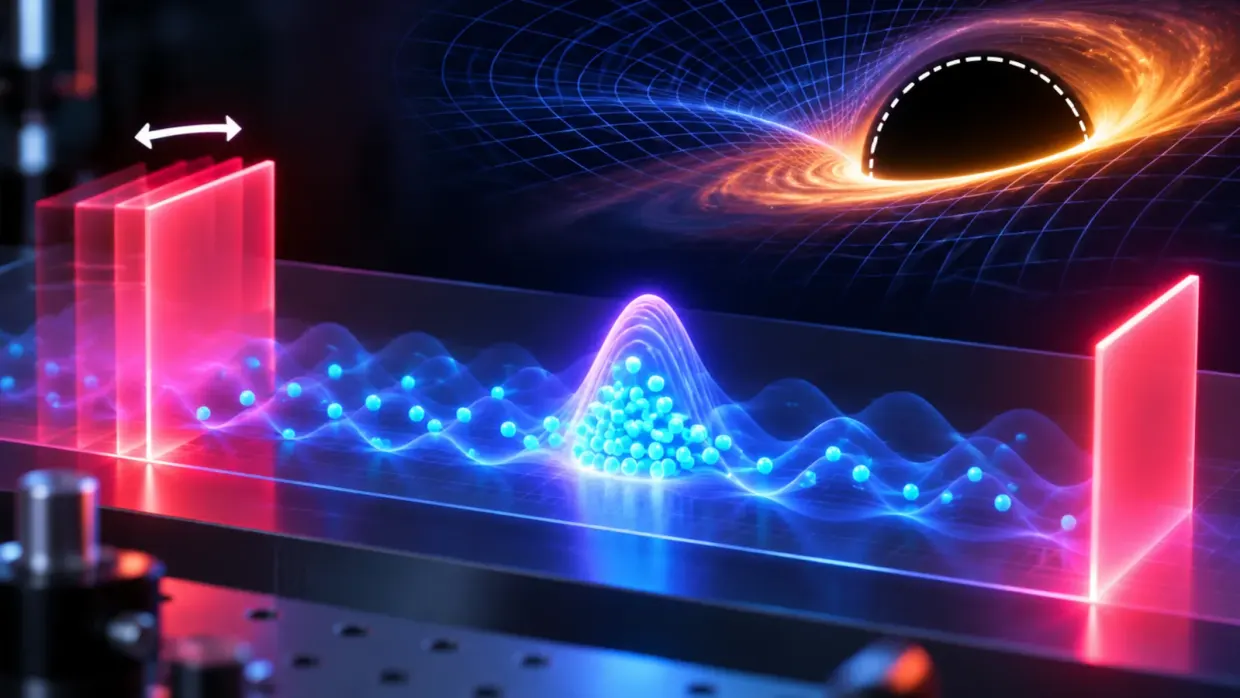
Researchers at the University of California, Santa Barbara (UCSB), led by Prof. David M. Weld, reproduced in the lab the wave behavior that models predict near the event horizon of a black hole, scinexx reports. They used ultracold lithium-7 atoms whose matter waves ran back and forth between two barriers of laser light. When one barrier oscillated at the right rhythm, the atoms gathered into a narrow packet scinexx.de
scinexxscinexx.deOpen source ↗.
Why an analog system is needed
The conditions at an event horizon in space cannot be changed deliberately, so it is hard to study experimentally. Part of the underlying wave dynamics can, however, be reproduced in other systems. In an optical resonator, light travels between two mirrors. Theory says that if one mirror oscillates in the right rhythm, the wave energy concentrates into short, intense pulses. With ordinary mirrors this would require an extremely strong acceleration that cannot be reached in the lab.
The team avoided this by using atoms cooled almost to absolute zero. The laser barriers act as mirrors for the atoms without being massive bodies. The atoms sat in an optical lattice that gave them nearly light-like wave propagation, but their speed was below one meter per second. It was therefore enough to move one light barrier about 100 times per second to imitate an extremely fast-driven optical resonator.
What the measurements showed
Without the moving barrier, the matter waves spread across the whole resonator. With the barrier oscillating at the resonance rhythm, the atoms condensed within a few cycles into a narrow, periodically moving packet. Regardless of their starting positions, the waves approached the same stable trajectory and moved away from a second, unstable one scinexx.de
scinexxscinexx.deOpen source ↗. In the theoretical model the unstable trajectory corresponds to the horizon of a black hole, and the stable one to that of a hypothetical white hole.
At roughly double the oscillation frequency, two bundled matter waves formed instead of one. An abrupt change of the oscillation phase swapped the stable and unstable trajectories, and the packet reversed its direction and approached its initial state.
The authors stress the limits. The experiment produces neither a real black hole nor its spacetime curvature; it confirms a predicted wave motion in a strongly driven resonator. Additional weak trajectories appeared that the simplified light model does not capture, because the matter waves do not travel at the same speed in all motion states. No particle creation from the quantum vacuum, as in the dynamical Casimir effect, was detected, and the result is not evidence of Hawking radiation. Weld said the observed dynamics and the possibility of realizing them in a solid-state platform point to methods for compressing and decompressing optical signals. That would require similar effects to be realized in suitable technical materials. The study appeared in Physical Review Letters (doi: 10.1103/44mq-jfp1).