Barley PhyC–VRN1 flowering module found in 505 Chinese cultivars and confirmed by base editing
Authors analysed 505 Chinese barley cultivars and found a PHYTOCHROME C–VRN1 module that speeds heading; base editing in barley and wheat confirmed it.
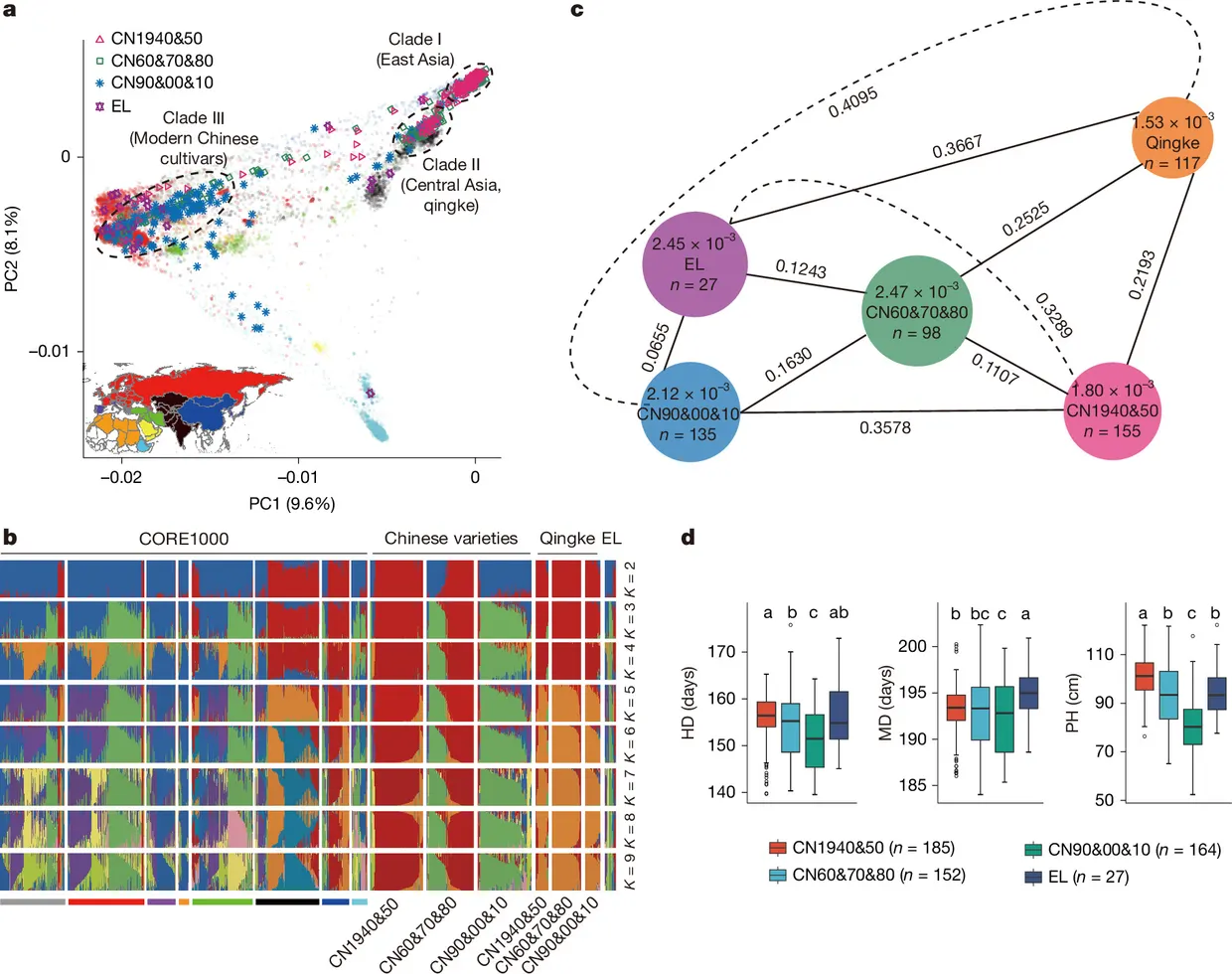
Researchers analysed the genomes of 505 representative barley cultivars from 80 years of modern breeding in China and identified a flowering-time module linked to double-season cropping, according to a paper in Nature nature.com
Naturenature.comOpen source ↗. The module consists of a single amino acid substitution in PHYTOCHROME C (PhyC) combined with a winter-type haplotype of VERNALIZATION 1 (VRN1). The authors confirmed its role by base editing in barley and wheat.
Flowering time in double-season cropping
In central and eastern China, barley has long been grown in a double-season cropping system. In this system, early flowering and maturation are critical for escaping presummer terminal heat stress and for flexible rotation with summer crops, the authors write. They add that adapting crops to intensive cultivation under climate change requires varieties that combine yield potential with optimized flowering and maturation.
The set of 505 cultivars is described as representative of modern breeding in China over eight decades. The authors used it to trace the genomic footprints of that breeding.
PhyC–VRN1 module and base editing
The team reports that the derived allele of PhyC accelerates heading and maturity nature.com
Naturenature.comOpen source ↗. According to the authors, its frequency has risen sharply in modern autumn-sown varieties. The combination of the PhyC substitution and the winter-type VRN1 haplotype is described as the module that underpins this adaptation.
To test causality, the researchers applied base editing in barley and wheat. They report that the PhyC–VRN1 flowering-time combination is functionally conserved across Triticeae.
The authors conclude that the module was selected during modern breeding to enable intensive crop rotations, and that it is a breeding-relevant module validated experimentally. They also state that precision genome editing can be used to reconstruct such adaptive modules for the design of climate-resilient crops. The available summary of the paper does not give numerical effects on heading date or maturity.