Pressure up to 2 GPa turns 6R-TaS2 superconductivity from nodal to nodeless, muon-spin data show
Muon-spin rotation on a 6R-TaS2 single crystal shows superfluid density rising under pressure, the charge density wave onset halving and the nonlinear Hall effect vanishing.
Researchers at the Paul Scherrer Institute (PSI) in Switzerland, led by Zurab Guguchia, studied the layered transition metal dichalcogenide 6R-TaS2 with muon-spin rotation, magnetotransport and hydrostatic pressure up to 2 GPa. The work, described on nature.com and published in Nature Communications, identifies a nodal superconducting state with low superfluid density at ambient pressure nature.com
nature.comnature.comOpen source ↗. Under pressure the pairing becomes nodeless.
Material and open questions
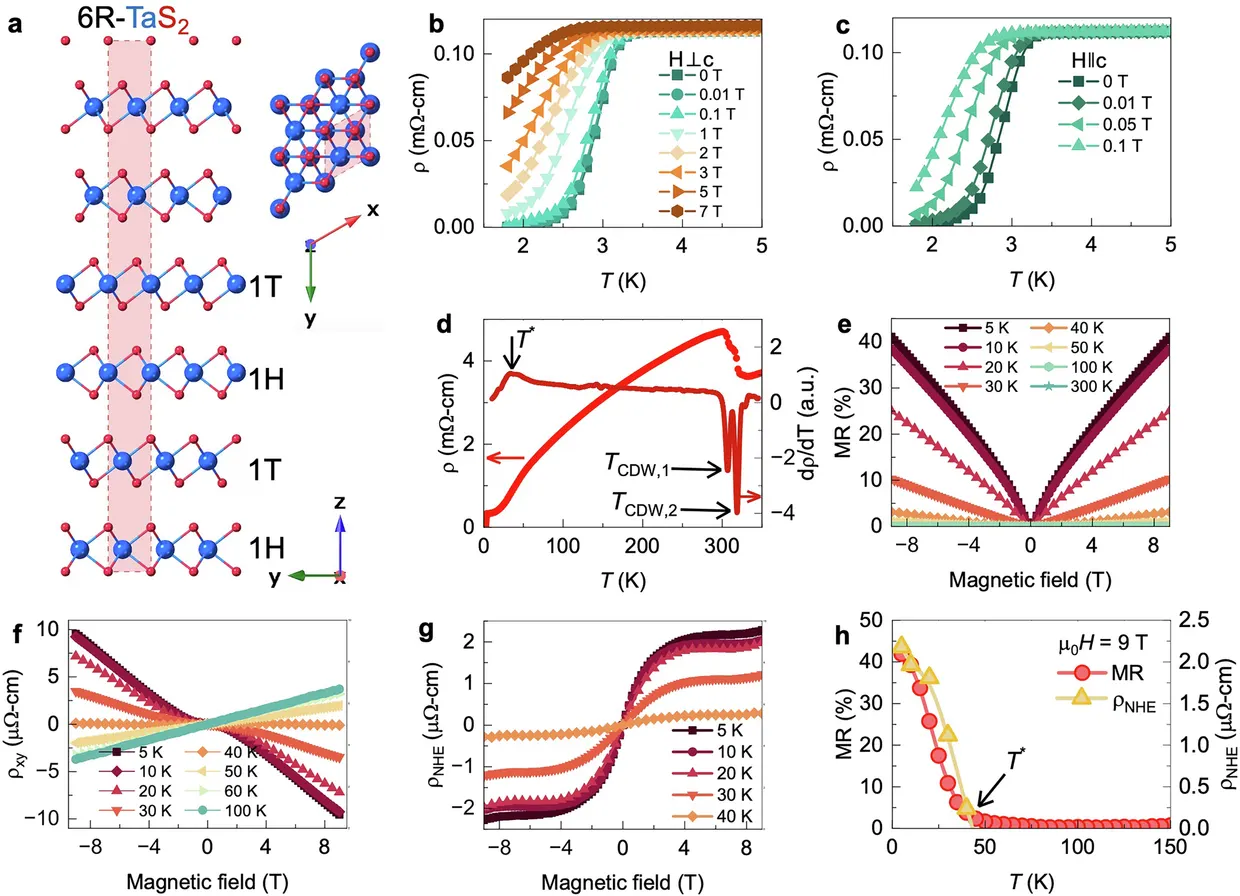
6R-TaS2 is a bulk heterostructure of alternating trigonal prismatic (1H) and octahedral (1T) layers. Earlier studies found a charge density wave (CDW) transition at about 305 K and a bulk superconducting transition at about 2.6 K, determined from magnetization measurements. Superconductivity was proposed to reside mainly in the 1H layers, separated by insulating 1T layers in the CDW state.
Below T* of about 40 K the material shows pronounced magnetoresistance and a nonlinear Hall effect (NHE), which had been interpreted as a sign of hidden magnetism. The gap symmetry, the superfluid density, the origin of the NHE and its relation to the CDW remained undetermined.
What pressure changed
Muon-spin rotation detected no spontaneous magnetic order below T*. According to the authors, this rules out magnetism as the origin of the NHE nature.com
nature.comnature.comOpen source ↗.
At pressures up to 2 GPa the superfluid density rises markedly, in correlation with the superconducting transition temperature. The nodal pairing shifts to a nodeless state, and the CDW onset is reduced by half. The NHE is fully suppressed and the magnetoresistance drops by 50% within just 0.2 GPa, which the authors take as evidence of the fragility of the state with the NHE.
The authors conclude that superconductivity, charge order and the nonlinear Hall effect compete in 6R-TaS2, driven by weakened interlayer coupling and shared electronic states. In the PSI team's account, compression brings the superconducting layers closer together and lets electrons localized in the insulating layers take part in superconductivity; they also report a sevenfold increase in the number of electrons involved.