U of A and Michigan build graphene harvester powering a battery-free temperature sensor
Researchers built a prototype graphene inductor that harvests energy from the 60 Hz magnetic field of power wiring and runs a nanowatt-scale temperature sensor without a battery.

Researchers at the University of Arkansas and the University of Michigan have reported a graphene-based energy harvester that uses ambient radiation to power an ultra-low-power temperature sensor, according to news.uark.edu. uark.edu
news.uark.edunews.uark.eduOpen source ↗ It is the team's second sensor of this kind: they previously reported graphene-based solar cells that can power temperature sensors. The paper was published in the Journal of Vacuum Science and Technology B.
The team's overall goal is autonomous sensors that draw power from several environmental sources: solar, thermal, acoustic, kinetic, nonlinear and ambient radiation. They set three requirements: locally harvested energy, an unattended service life potentially measured in decades, and operation at nanowatt-scale power. According to the university, the latest sensor meets all three.
How the graphene harvester works
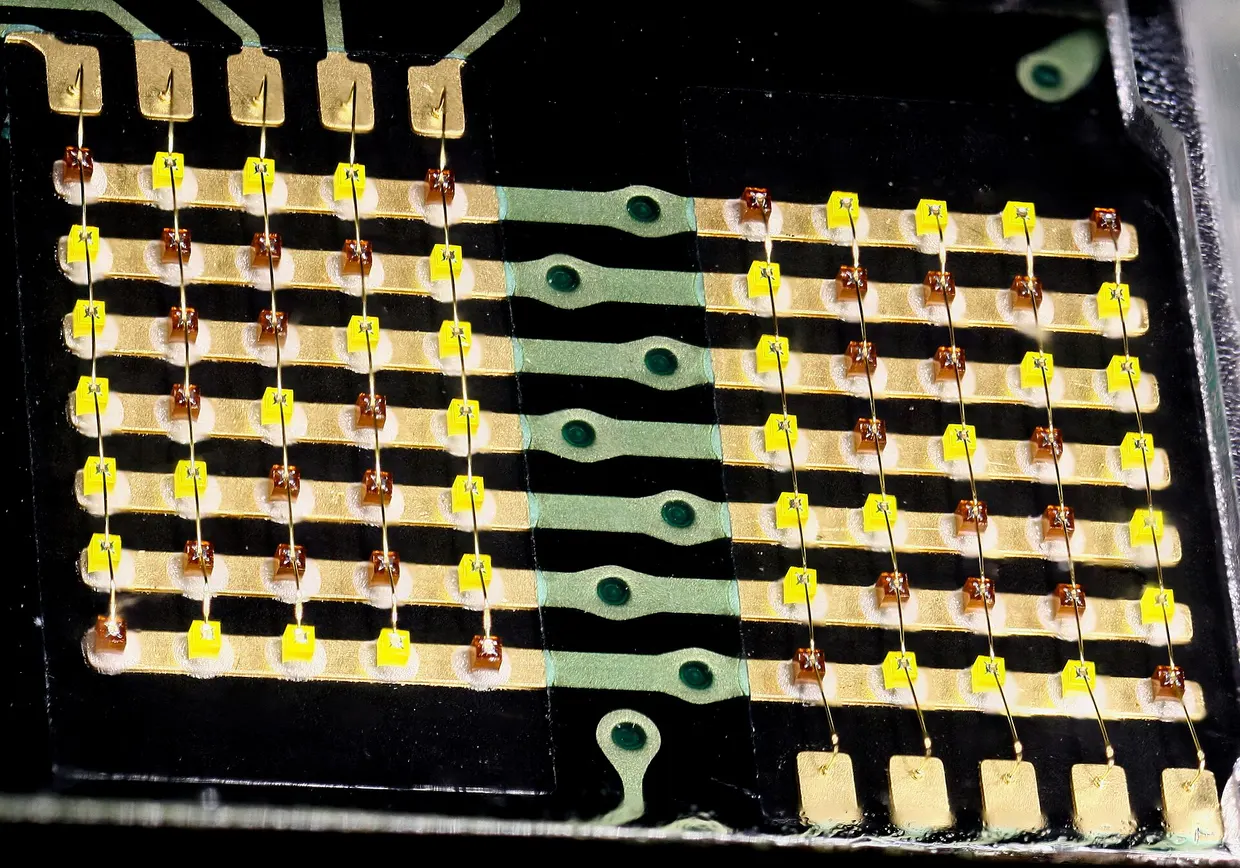
The sensor is designed around the standard 60 Hz electrical frequency used in the U.S. A graphene inductor harvests energy from the magnetic fields created by power lines. Its signal feeds a custom circuit that converts AC to DC and charges the capacitors in the sensor. New Atlas adds that the inductor has a steel core, that the circuit is based on a Cockcroft-Walton voltage multiplier, and that the energy is stored in three capacitors rather than in a rechargeable battery.
Paul Thibado, professor of physics at the University of Arkansas, said the inductor adds charge to the capacitors slowly, but faster than the sensor uses it. If the power goes out, the sensor can keep drawing on the capacitors. In his estimate, it can easily last 24 hours, probably a week. uark.edu
news.uark.edunews.uark.eduOpen source ↗
Applications and licensing
The temperature sensors are a proof of concept. Thibado sees possible uses in product tracking, atmospheric monitoring, logistical fleet management, soil and wearable fitness monitoring, and medical tracking. Because the sensors need no batteries, the cost, effort and waste of replacing them are reduced. The end goal is multi-modal sensors that combine sources, for example ambient radiation and kinetic movement, so that one source backs up the other during an outage.
The first author is MD Rezaul Kabir, a Ph.D. candidate in the Materials Science and Engineering Program. The graphene energy harvesters are the invention of Thibado, the corresponding author. Co-authors from Michigan include David Blaauw, a professor of electrical engineering and computer science.
NTS Innovations holds the exclusive license to develop the harvesters into commercial products and has funded patenting, business plans, partner search and customer discovery. More than 60 parties have expressed interest in testing the technology and integrating it into their applications. uark.edu
news.uark.edunews.uark.eduOpen source ↗