M87* black hole mass from stellar motions put at 5.38 billion solar masses using Webb and Keck data
Astronomers used stellar velocities to put the mass of M87* at 5.38 billion solar masses, below the estimates from its shadow. The result is in an arXiv preprint.
A team led by Emily R. Liepold of the University of California (USA) estimated the mass of the supermassive black hole M87* from the motion of the surrounding stars. According to Naked Science, the mass came out at 5.38 billion solar masses, about a billion less than the first estimates based on the size of the ring in the image naked-science.ru
Naked Sciencenaked-science.ruOpen source ↗. M87* sits at the center of the elliptical galaxy Messier 87, about 55 million light-years from Earth. The results are posted on the arXiv.org preprint server.
How the mass was estimated before
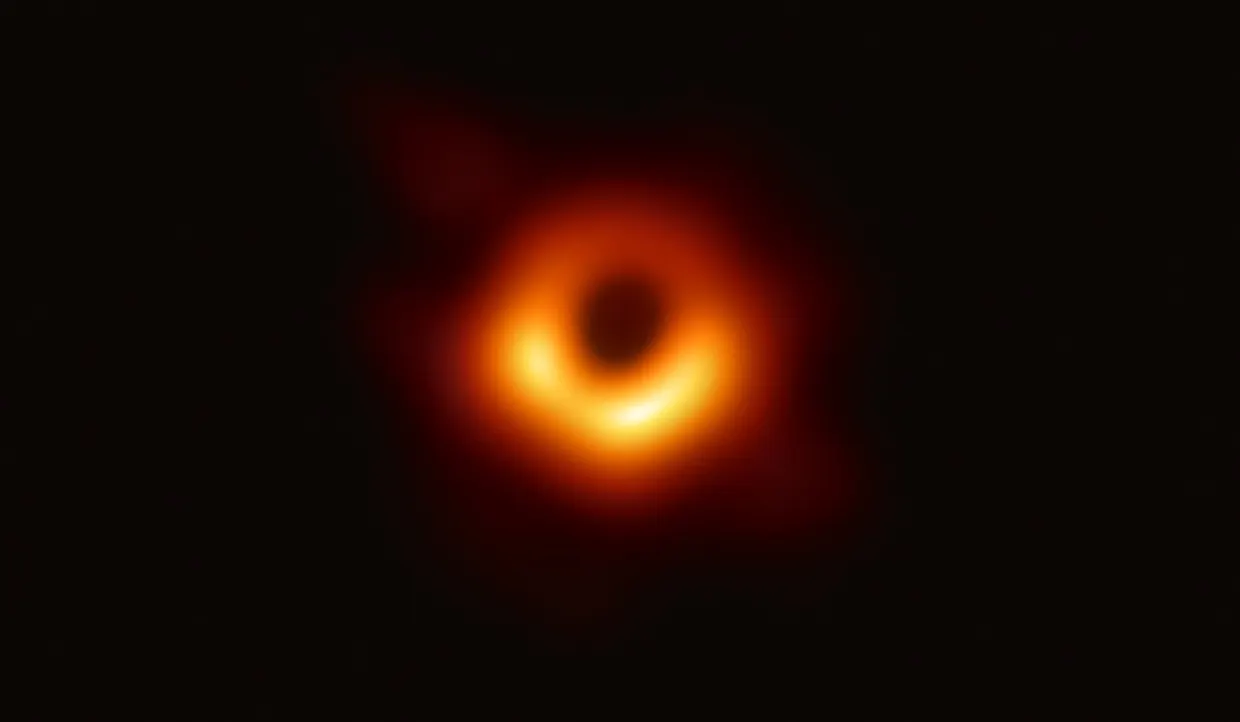
In 2019 the Event Horizon Telescope (EHT) produced an image showing a bright ring of emitting matter around a dark region linked to the black hole's shadow. From the ring size, the mass was estimated at about 6.5 billion solar masses. A later analysis of the 2017 and 2018 observations gave about 6.16 billion.
Another method relies on gravity, which shapes stellar orbits: the closer a star is to the galactic center, the stronger the black hole's influence. By measuring the velocities of many stars and building a model of their motion, one can calculate the mass needed to produce the observed gravitational field.
Data and modeling
The researchers combined data from the James Webb Space Telescope and the Keck Observatory. Webb covered stars about 33 light-years from the center of M87, while Keck covered distances up to 32,600 light-years, so the scales differ by a factor of thousands naked-science.ru
Naked Sciencenaked-science.ruOpen source ↗. The Webb spectra contained periodic distortions, so the team developed a data-cleaning algorithm. Closer to the center, the velocity dispersion reaches about 500 kilometers per second.
The team then built computer models of the galaxy that account for gravity, stellar mass, dark matter and the complex three-dimensional shape of M87*. For comparison with observations they used nearly five thousand measurements of stellar motion in 618 regions of the galaxy.
The statistical uncertainty of the estimate is plus or minus 130 million solar masses. An additional uncertainty of 220 million comes from the distance to the galaxy. The result agrees with the earlier stellar-dynamics estimate, while possible measurement errors were reduced by a factor of two to three.
The new data do not refute the earlier estimates: within the uncertainties, both methods give close results. The refined mass is expected to help study the black hole's rotation and the behavior of the hot gas around it.