HZDR and Rostock physicists make 3 nm nanodiamonds from PET film with a laser at ELI Beamlines
A laser pulse on PET film yields about 10 trillion nanodiamonds in a lab experiment; a soft gel let researchers recover them intact for the first time.
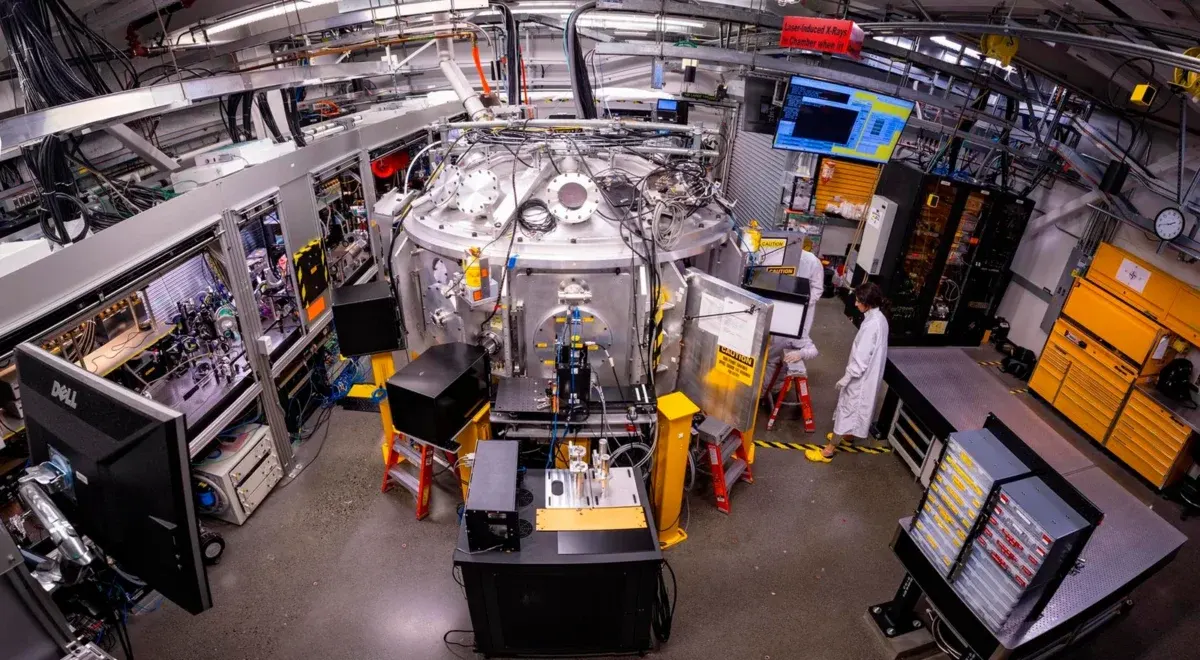
Physicists from the Helmholtz-Zentrum Dresden-Rossendorf (HZDR) and the University of Rostock have described a laboratory experiment in which one laser shot at a plastic film produces about 10 trillion nanodiamonds, according to science-et-vie.com. The work was carried out at ELI Beamlines, a laser facility south of Prague in the Czech Republic, and described in August 2026. For the first time the team recovered the crystals intact. science-et-vie.com
science-et-vie.comscience-et-vie.comOpen source ↗ Each crystal is about 3 nanometres across.
How the laser turns PET into diamond
The target is a 100-micrometre-thick strip of PET, the polymer used in water bottles. The laser fires three times per minute, and the strip advances after each pulse. Each shot launches a shock wave that compresses the plastic to nearly 100 gigapascals, about a million times atmospheric pressure. Within a few nanoseconds the carbon rearranges into a diamond structure.
Right after formation the nanodiamonds are ejected at more than ten kilometres per second. At that speed they would shatter against a rigid surface. The team placed a water-soluble gel behind the film, soft enough to cushion the impact. Once dissolved in water, the gel releases the particles intact.
Earlier measurements by the team show that more than half of the carbon atoms in the plastic end up as diamond during the shot.
Size and comparison with industrial methods
Under an electron microscope the crystals average 3.23 nanometres, and each contains about 3,000 carbon atoms. Among the 98 crystals measured, the spread in size stays under one nanometre. science-et-vie.com
science-et-vie.comscience-et-vie.comOpen source ↗
Industry currently makes nanodiamonds by detonating explosives. According to the study published in Diamond and Related Materials, those particles are about 5 nanometres, often contain traces of metals and must be cleaned with boiling acid before use.
The authors suggest that other atoms could be inserted into the crystal lattice during compression to tune the properties for a given application; explosives do not offer such tuning. Nanodiamonds are already used for polishing and abrasion. Smaller particles would speed up chemical reactions because of their proportionally larger surface. HZDR also considers them as MRI contrast agents or as quantum sensors able to detect very weak magnetic fields.
Three shots per minute are not enough for practical production. The team envisages a laser firing ten times per second, with a water bath collecting the grains continuously. An experiment planned for November 2026 targets another material, BC8, a form of carbon so far only calculated, which would be denser than diamond and less brittle. science-et-vie.com
science-et-vie.comscience-et-vie.comOpen source ↗