Harvard team engineers Alteromonas macleodii to speed olivine dissolution 2.6-fold in pilot reactors
Engineered marine bacteria raised the olivine dissolution rate 2.6-fold, and pilot reactors on seawater removed 0.50 g of CO2 per day from air through alkalinity.
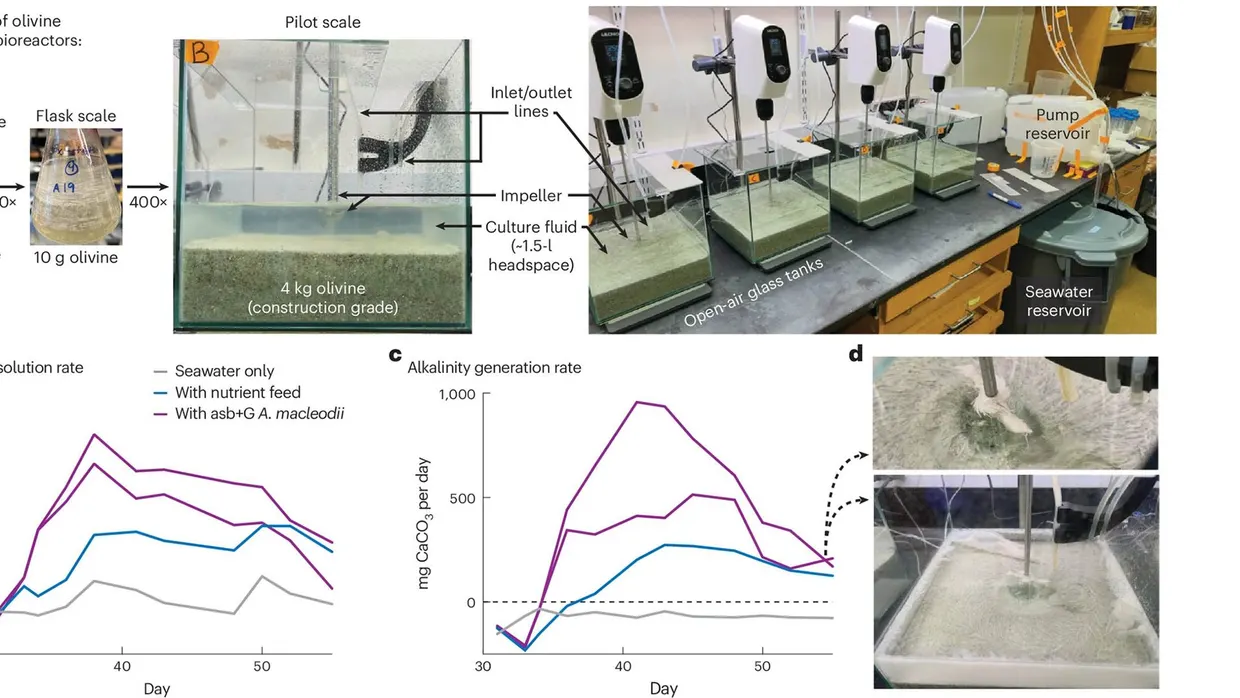
Researchers from Harvard Medical School, the Wyss Institute and the Stanford Doerr School of Sustainability engineered the marine bacterium Alteromonas macleodii to accelerate the dissolution of olivine, according to a paper in Nature Biotechnology. The modified cells increased the dissolution rate 2.6-fold. In pilot-scale reactors with engineered cells, the authors directly measured removal of 0.50 g of CO2 per day from the air through alkalinity generation nature.com
Nature Biotechnologynature.comOpen source ↗.
Why natural bacteria fall short
Weathering of silicate minerals can capture and store CO2, but it is too slow for industrial use. Iron released from olivine would otherwise passivate the mineral surface, and bacteria can counter this by secreting siderophores, molecules that solubilize the iron.
In 16 small lab reactors with different amounts of olivine sand and different flow rates, the natural strain produced large amounts of siderophore only with little rock and fast flow. With more rock the cells had iron to spare and stopped. The authors concluded that natural genetic regulation precludes continuous siderophore production in mineral bioreactors.
The team replaced the switch that turns production on only under iron shortage with one that keeps it on. In small reactors the engineered strain made more than 100 times as much siderophore as the natural one. Olivine dissolved 2.6 times faster than in reactors without cells, while the natural strain made no clear difference nature.com
Nature Biotechnologynature.comOpen source ↗.
Pilot reactors and limits
A life cycle analysis showed that renewable feedstocks and minimal replenishment of modified cells are critical for net CO2 removal at scale. Sugar was rejected: its production emits too much, and in the lab it left the water less alkaline. The team used acetate. With engineered cells and a carbon-neutral acetate feed, the model gave 74 percent more net removal than rock and seawater alone, assuming the 2.6-fold speedup holds at scale.
The pilot setup used 11-liter glass tanks with more than 4 kg of olivine sand each and unfiltered Boston Harbor seawater at about 1.5 liters per day. In two tanks that received nutrients and a weekly dose of engineered cells, magnesium was released 3.1 times faster. A control reactor without cells did not generate alkalinity in net.
After about three weeks, dissolution and carbon uptake fell in every tank. Microbial films built up on the glass and the sand, and the authors suspect they blocked the rock. Breaking up the top sand layer might help, but this was not tested. The work has not been done in open water, and the study did not analyze the economics of capture. Four of the authors have filed a patent application on the strains.