Genomes of 64 young individuals from a Chichén Itzá mass burial: all male, two pairs of twins
Genome-wide data from 64 subadults buried near the Sacred Cenote show all were male, with 11 close-relative pairs and two pairs of identical twins.
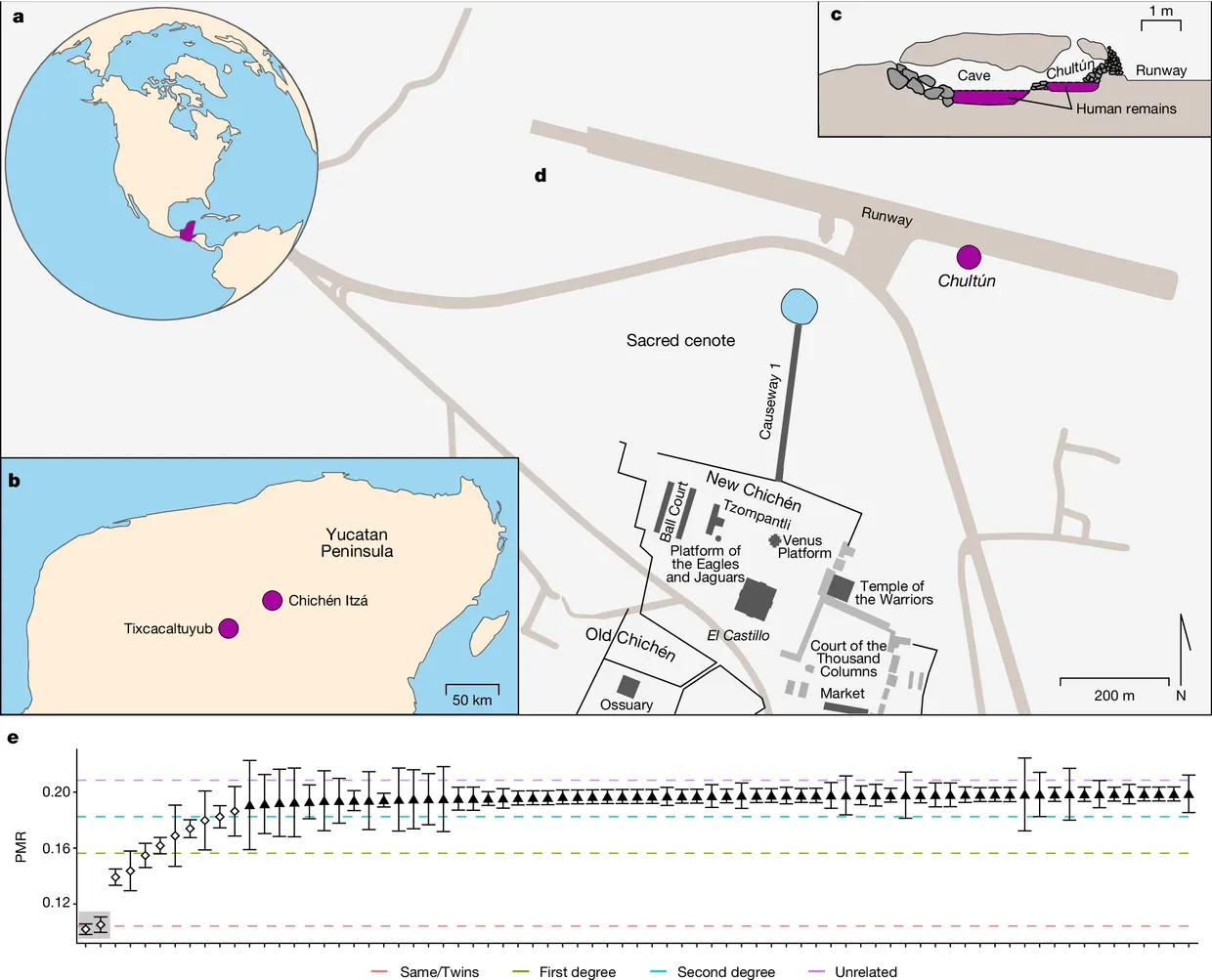
A team of researchers has published genome-wide data from 64 subadult individuals dated to around AD 500–900, according to nature.com. The remains were found in a subterranean mass burial near the Sacred Cenote, in the ceremonial centre of Chichén Itzá, Yucatán, Mexico nature.com
nature.comnature.comOpen source ↗. The authors compared the ancient data with 68 present-day Maya inhabitants of the region.
The burial is a chultún, an underground cistern, discovered in 1967. It contained the remains of more than 100 subadults and is connected to a small cave.
Sex and kinship
Genetic analysis showed that all analysed individuals were male. Several were closely related: the pairwise mismatch rate identified 11 close-relative pairs, including two pairs of monozygotic twins. A low mismatch rate among unrelated individuals, according to the authors, confirms low genetic diversity in the population.
Twins feature prominently in Mayan and wider Mesoamerican mythology, where they embody duality among deities and heroes. Until now they had not been identified in ancient Mayan mortuary contexts nature.com
nature.comnature.comOpen source ↗.
Context of the site
Chichén Itzá was one of the largest Maya settlements of the Late and Terminal Classic periods (AD 600–1000). The Sacred Cenote, a sinkhole connected to the northern ceremonial centre by a limestone causeway, contains ritual offerings and the remains of more than 200 sacrificed individuals, mostly children.
Sixteenth-century Spanish accounts popularized the idea that mainly young women and girls were sacrificed. More recent osteological analyses indicate that both males and females were deposited in the Sacred Cenote. Because most sacrificed individuals at Classic Maya sites are juveniles, conventional osteology alone cannot determine precise sex distributions. Isotopic studies suggest that at least some individuals in the Sacred Cenote were non-local.
Link to present-day people
Comparison with present-day inhabitants shows genetic continuity with the ancient population of Chichén Itzá nature.com
nature.comnature.comOpen source ↗. The exception is a set of loci related to immunity, including the human leukocyte antigen complex. The authors interpret this as signals of adaptation to infectious diseases introduced to the region during the colonial period.