Anthropic biologists solve first 3D structure of a bacterial vault: 96 copies of phage protein L05
Cryo-EM showed phage protein L05 assembles into a 9.5-megadalton particle, which could give researchers a simpler way to study vaults in human cells.
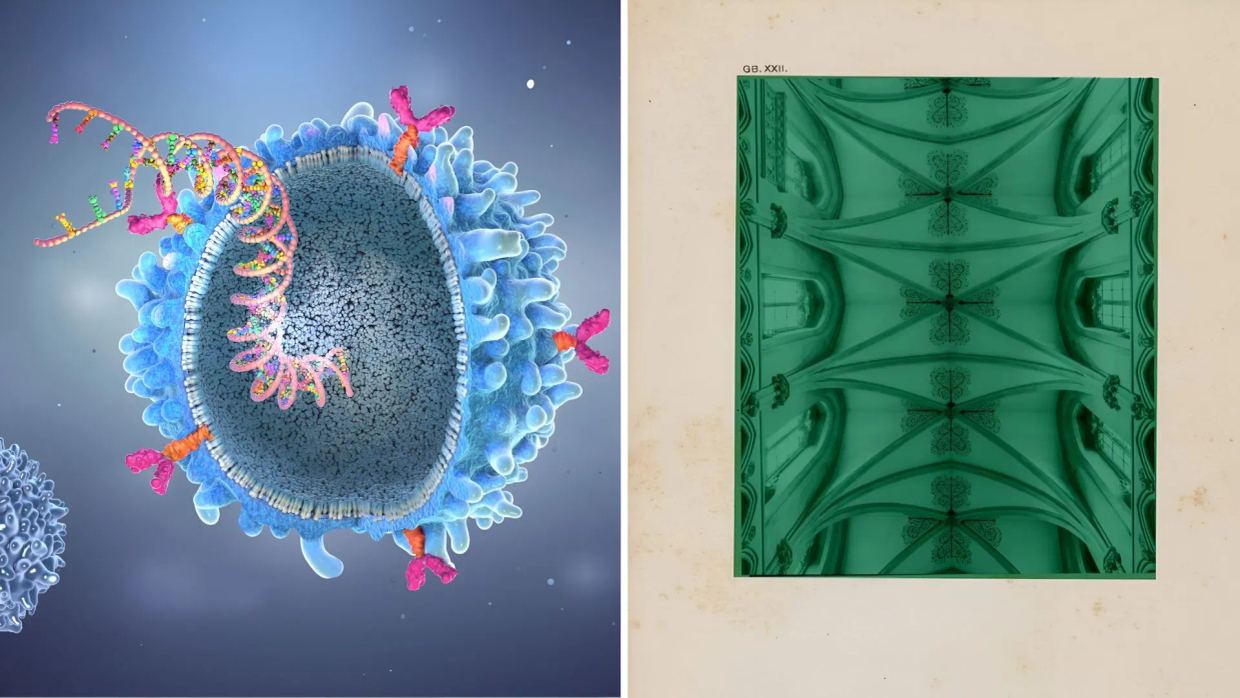
The biology research team at Anthropic has mapped the first three-dimensional structure of a vault particle from bacterial life, Interesting Engineering reports. The particle is built from a bacteriophage protein called L05. It contains 96 copies of the protein and has a mass of approximately 9.5 megadaltons. interestingengineering.com
Interesting Engineeringinterestingengineering.comOpen source ↗
Vault particles were first identified in 1986 by Leonard Rome and Nancy Kedersha. They are hollow, barrel-shaped complexes and rank among the largest protein assemblies in human cells. Mammalian vaults contain 78 copies of a major protein arranged in two symmetrical halves. Their function is still not established: roles in cellular transport, drug resistance and immune defense have been proposed, but no experiment has confirmed any of them. Common laboratory organisms lack vaults, which complicates the work. interestingengineering.com
Interesting Engineeringinterestingengineering.comOpen source ↗
Search for vault proteins and the L05 structure
The team searched approximately 15 billion predicted protein sequences for distant relatives of vault proteins. Candidates turned up in 29 major bacterial groups and four groups of archaea, and 44 of them were selected for laboratory testing. Seven of the 15 successfully produced proteins assembled into vault-like particles. Cryo-EM confirmed the structures of four candidates: two from bacteria and two from bacteriophages. interestingengineering.com
Interesting Engineeringinterestingengineering.comOpen source ↗
For detailed analysis the researchers chose the phage protein L05. The resulting particle measures approximately 54 nanometers in length and 45 nanometers in width. Despite being shorter, it encloses approximately 25 percent more volume than mammalian vaults. interestingengineering.com
Interesting Engineeringinterestingengineering.comOpen source ↗
To study how these structures grow, the researchers added two repeating segments to the protein. The particle became larger, and its enclosed volume increased by approximately 20 percent. According to the authors, this suggests that protein duplication could have helped vaults evolve different sizes. The experiments also showed that small structural changes can prevent particles from closing properly. interestingengineering.com
Interesting Engineeringinterestingengineering.comOpen source ↗
Faster methods and the open question
Traditional purification of the particles takes approximately three days. The team developed a chromatography-based approach that reduced the process to roughly 90 minutes. The first complete structural model from the cryo-EM data was obtained within 34 hours; the team estimates that conventional analysis could take several weeks. interestingengineering.com
Interesting Engineeringinterestingengineering.comOpen source ↗
The work also had setbacks. One experimental protocol introduced an additive that interfered with DNA delivery and delayed the research by two weeks. An inaccurate structural map was produced after a standard processing step was skipped. The researchers corrected both problems through closer supervision. interestingengineering.com
Interesting Engineeringinterestingengineering.comOpen source ↗
The central question remains open: what vault particles actually do inside living organisms. Leonard Rome described it as enormously challenging. The new structure offers another route toward an answer, but much of the biology is still unexplored. interestingengineering.com
Interesting Engineeringinterestingengineering.comOpen source ↗