Copenhagen team's 712 ancient genomes suggest Germanic reached Scandinavia about 4,000 years ago
Sequencing of ancient DNA revealed a previously elusive population that entered Sweden by about 4,000 years ago, roughly 800 years later than the traditional date for Germanic's arrival.
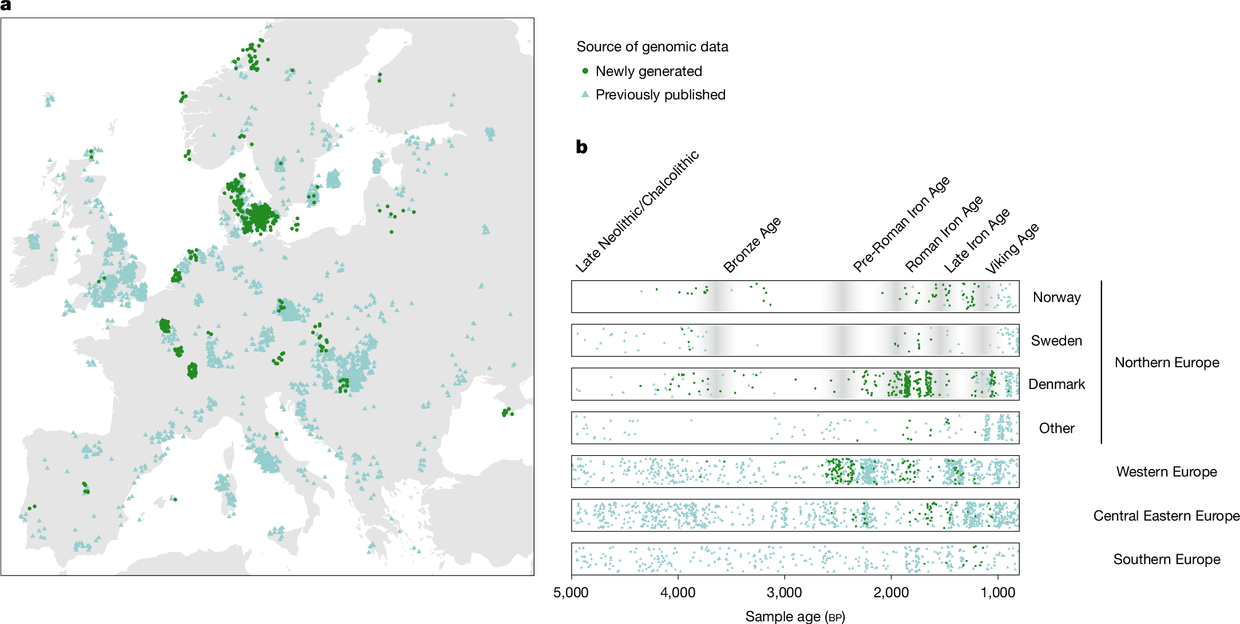
Researchers at the University of Copenhagen, led by Eske Willerslev, sequenced 712 ancient human genomes and analysed them together with 4,009 previously published ones, according to a paper on nature.com. nature.com
nature.comnature.comOpen source ↗ The authors report an archaeologically elusive population that entered Sweden, likely from the Baltic region, by around 4,000 years before present (BP).
nature.com
nature.comnature.comOpen source ↗ The work addresses when and where the Germanic branch of Indo-European, which includes German, English, Frisian, Dutch and the Nordic languages, arrived in the north.
The timing of that arrival has been contested. Steppe-related ancestry reached Europe around 5,000 BP, and the Corded Ware and Bell Beaker complexes have been associated with the introduction of Germanic to Scandinavia. nature.com
nature.comnature.comOpen source ↗ Between those first waves (about 5,000–4,500 BP) and the first runic inscriptions, the earliest Germanic written evidence (about 1,950–1,550 BP), lies a gap of two to three millennia.
nature.com
nature.comnature.comOpen source ↗ Loanword contacts with Celtic- and Finno-Saamic-speaking groups suggest an early form of Germanic existed between northern Germany and the East Baltic by the Late Bronze Age (3,200–2,800 BP).
nature.com
nature.comnature.comOpen source ↗
A new ancestry in Scandinavia
The final imputed dataset contained 578 new and 4,009 published individuals, covering 690,211 SNPs. nature.com
nature.comnature.comOpen source ↗ The team used identity-by-descent clustering, mixture modelling and spatio-temporal kriging to follow ancestry through time.
nature.com
nature.comnature.comOpen source ↗ The population that appeared in Sweden by about 4,000 BP became widespread across Scandinavia by 3,500 BP.
nature.com
nature.comnature.comOpen source ↗ According to the authors, it offers a potential route for Germanic into Scandinavia some 800 years later than traditionally assumed.
nature.com
nature.comnature.comOpen source ↗
Migrations in the Iron Age and after
After Germanic split into its descendant languages in the Late Iron Age, the authors observe a southward migration from southern Scandinavia by 1,650 BP into presumed Celtic-speaking areas, including present-day Germany, Poland and the Netherlands. nature.com
nature.comnature.comOpen source ↗ During the Migration Period (1,575–1,375 BP), this ancestry appears among Anglo-Saxons in Britain and Langobards in southern Europe.
nature.com
nature.comnature.comOpen source ↗
In the same period the team identifies a related large-scale northward back-migration into Denmark and southern Sweden. nature.com
nature.comnature.comOpen source ↗ It coincides with the rise of Danish influence and the linguistically documented emergence of Old Norse.
nature.com
nature.comnature.comOpen source ↗ The authors conclude that multiple migrations and locations shaped the arrival and formation of Germanic and its divergence into historical and modern languages.
nature.com
nature.comnature.comOpen source ↗