0.43 at.% carbon raises elongation of an AlCrFeNi high-entropy alloy from 12.7% to 20.4% in lab ingots
Researchers at Northwestern Polytechnical University changed the solidification of eutectic high-entropy alloys with trace carbon, in arc-melted laboratory ingots.
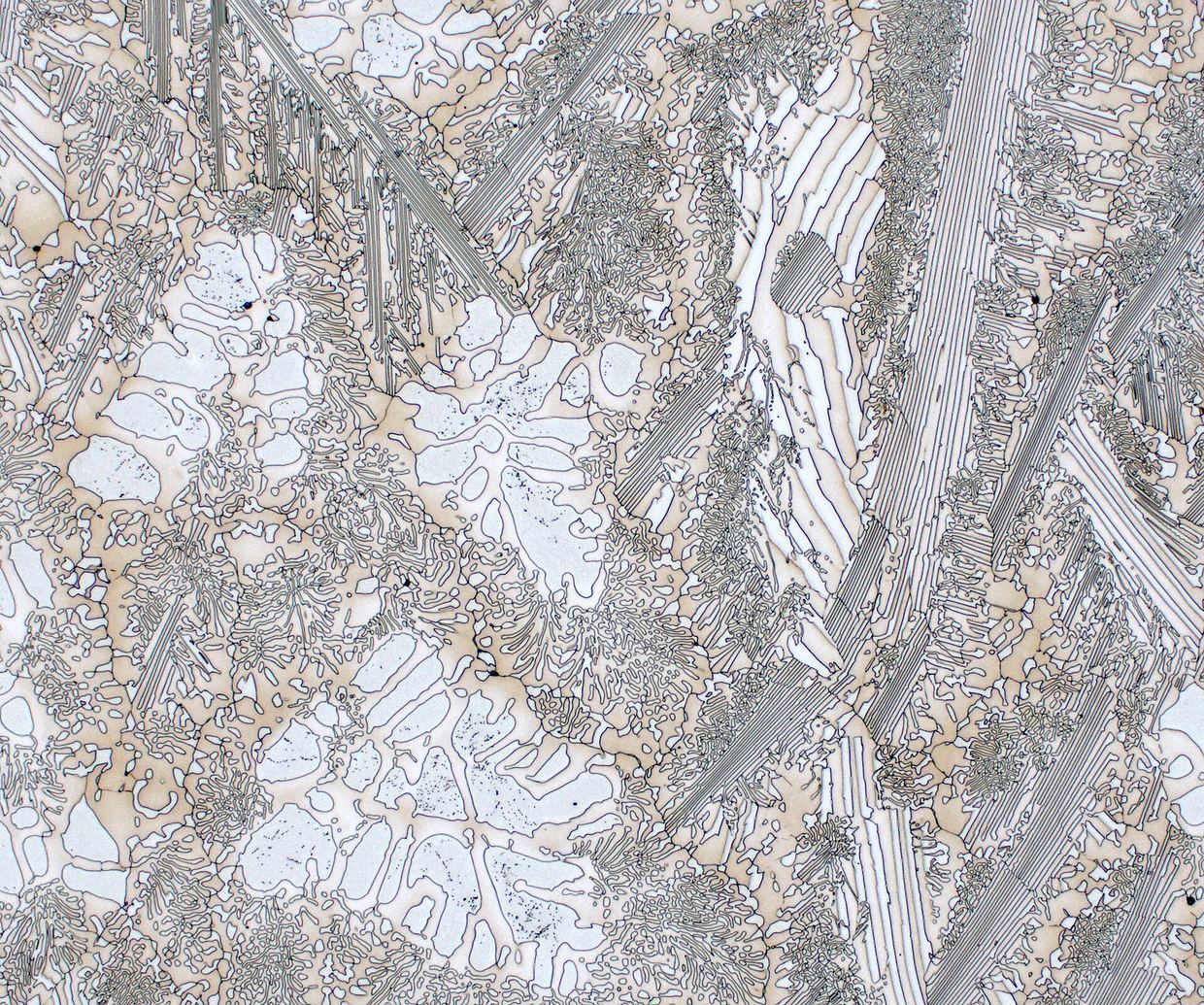
A team led by Xiaoyu Bai and Zhijun Wang of Northwestern Polytechnical University (Xi'an, China), with Xiaoguang Fan and Hyoung Seop Kim of POSTECH, reported in The Innovation Insights that carbon changes how eutectic high-entropy alloys (EHEAs) with FCC and B2 phases solidify. Adding 0.43 at.% carbon to a base Al17Cr12Fe35Ni36 alloy raised elongation from 12.7% to 20.4% doi.org
The Innovation Insightsdoi.orgOpen source ↗.
The work is confined to arc-melted AlCrFeNi-based laboratory ingots. The authors present carbon engineering as a complement to thermodynamic design, not a replacement for it.
Carbon as a kinetic activator of eutectic solidification
EHEA design has so far followed a thermodynamic approach: the aluminum content is adjusted until the phases balance. The authors add a kinetic variable, namely whether the FCC and B2 phases nucleate at matching rates. Carbon was introduced from an Fe-C master alloy doi.org
The Innovation Insightsdoi.orgOpen source ↗.
At 0.43 at.% carbon, the primary B2 phase was suppressed and a fully coupled, finely lamellar FCC/B2 eutectic formed instead of a hypereutectic structure. According to the authors, carbon reduces the lattice mismatch between the phases and lowers the undercooling threshold for FCC nucleation by roughly 12% doi.org
The Innovation Insightsdoi.orgOpen source ↗.
At 3.34 at.% carbon, chromium-rich M7C3 carbides solidify first. They enrich the surrounding liquid in nickel and aluminum, and their semi-coherent interface promotes B2 nucleation. The FCC/B2 growth decouples into separate dendrites, and the remaining liquid solidifies as a secondary FCC/M7C3 nano-eutectic with a high density of nanoscale carbides doi.org
The Innovation Insightsdoi.orgOpen source ↗.
Strength, ductility and deformation mechanisms
The base alloy had a yield strength of 497 MPa and 12.7% elongation. The 0.43 at.% carbon alloy reached 532 MPa yield strength and 1,228 MPa tensile strength with 20.4% elongation. The 3.34 at.% carbon alloy reached 629 MPa yield strength and 1,293 MPa tensile strength with 11.6% elongation doi.org
The Innovation Insightsdoi.orgOpen source ↗.
Microscopy points to two mechanisms. Interstitial carbon increases dislocation storage in the FCC phase and promotes the coordination of several slip modes, including cross-slip and nanotwins. At high carbon content, the FCC/M7C3 nano-eutectic acts as a mechanical transition layer that eases stress transfer between the soft FCC and hard B2 phases, so the structure deforms jointly doi.org
The Innovation Insightsdoi.orgOpen source ↗.
The alloys have a density of 7.15–7.20 g/cm³ and are made from inexpensive elements. The authors name combinations with heat treatment, deformation processing and additive manufacturing as next steps doi.org
The Innovation Insightsdoi.orgOpen source ↗.