KM3NeT/ORCA6 finds no Lorentz invariance violation in 1.4 years of atmospheric neutrino data
The first six detection units of the KM3NeT/ORCA telescope set new limits on a Lorentz invariance violation model, without assuming the flavour ratios of astronomical neutrinos.
On 10 March 2026 the KM3NeT collaboration presented, on km3net.org, a search for isotropic Lorentz invariance violation. It used 1.4 years of atmospheric neutrino data collected with ORCA6, the first six detection units of the ORCA detector in the Mediterranean Sea km3net.org
km3net.orgkm3net.orgOpen source ↗. No violation was observed, but the analysis places new constraints on a widely studied model of Lorentz invariance violation (LIV)
km3net.org
km3net.orgkm3net.orgOpen source ↗.
Lorentz invariance is a fundamental symmetry underlying modern physics. A violation could show up as deviations from standard neutrino oscillations, so atmospheric neutrinos can be used to test it km3net.org
km3net.orgkm3net.orgOpen source ↗. The work was carried out by the KM3NeT collaboration together with researchers of Friedrich-Alexander-Universität Erlangen-Nürnberg led by Lukas Hennig.
Detector and data
ORCA is an underwater telescope about 40 km off Toulon, installed at a depth of roughly 2,450 m. Charged particles produced in rare neutrino interactions near the sensors emit Cherenkov light, from which the energy and direction of the neutrino are reconstructed. Data taken between January 2020 and November 2021 gave 510 days of usable time after quality selection. The sample contains about 5,800 neutrino events, divided into three classes by their light patterns.
The team compared measured energies and arrival directions with the predictions of standard oscillations. Statistical fits then checked whether additional effects from the LIV model describe the data better. In each fit only one extra model parameter was allowed to differ from zero, and only isotropic violations, with no preferred spatial direction, were tested.
Limits and comparison
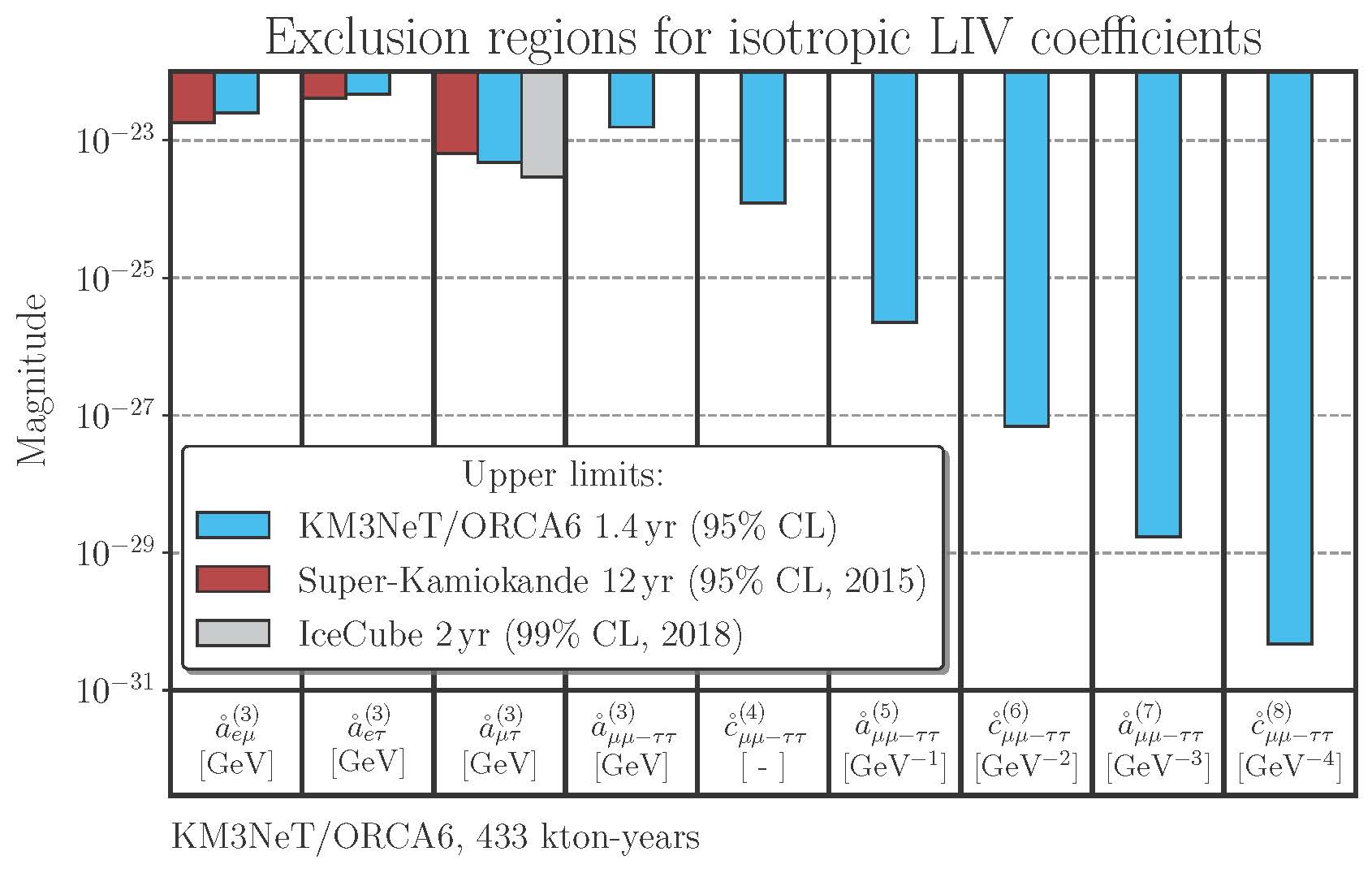
None of the tested variants showed a statistically significant sign of Lorentz invariance violation. The strictest upper limit concerns a parameter that affects the conversion between muon and tau neutrinos: 4.8 × 10⁻²⁴ GeV at the 95% confidence level. This value describes a quantity of the theoretical model and is not a directly measured energy change of neutrinos.
With ORCA6 the collaboration established the first upper limits on isotropic diagonal LIV coefficients in the neutrino sector that do not rely on assumptions about the initial flavour ratios of astronomical neutrinos km3net.org
km3net.orgkm3net.orgOpen source ↗. According to the authors, this model-independent approach makes the constraints more robust and more generally applicable
km3net.org
km3net.orgkm3net.orgOpen source ↗.
The results were compared with about 12 years of Super-Kamiokande data and a two-year IceCube analysis of atmospheric neutrinos. The authors report competitive results despite the small size of ORCA6 and the short operating time in this configuration km3net.org
km3net.orgkm3net.orgOpen source ↗. The paper has been submitted to the Journal of Cosmology and Astroparticle Physics and is available as a preprint at arXiv:2603.04264
km3net.org
km3net.orgkm3net.orgOpen source ↗.