MIT team assembles nanoparticles with flexible ligands into previously unseen crystal structures
Researchers from MIT and the University of Delaware used flexible charged ligands instead of rigid ones, controlling bonds per nanoparticle in laboratory experiments.
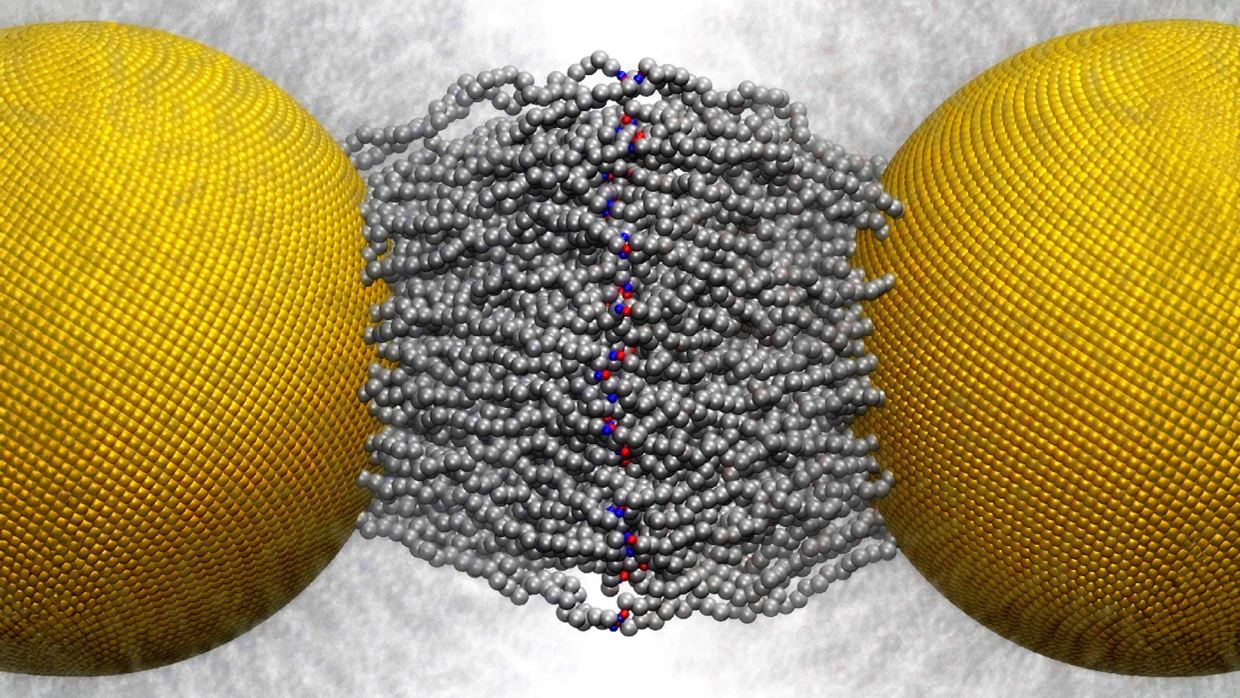
Researchers from MIT and the University of Delaware have developed a way to assemble nanoparticles using highly flexible connector molecules instead of rigid ones. The work is described in a paper in Nature Materials and reported by news.mit.edu. mit.edu
news.mit.edunews.mit.eduOpen source ↗ According to the authors, the approach produced nanoparticle crystal structures that had not been observed before.
mit.edu
news.mit.edunews.mit.eduOpen source ↗
The MIT part of the work was led by Rob Macfarlane, a professor in the Department of Materials Science and Engineering. The co-authors are PhD candidate Nicholas Sbalbi, University of Delaware doctoral student Stephen Kronenberger, undergraduate Hana Shinzawa, Matthew Ye and former Delaware professor Arthi Jayaraman. mit.edu
news.mit.edunews.mit.eduOpen source ↗
Why rigid connectors were the standard
A material's properties follow from its building blocks and their arrangement. Individual nanoparticles are already used in drug delivery, energy storage, computing and sensing, but assembling them into larger structures is difficult because the particles tend to pack tightly. mit.edu
news.mit.edunews.mit.eduOpen source ↗
Two existing strategies change the particle shape or make only specific parts of the surface sticky. Both require the connector molecules (ligands) on the surface to be rigid, so that they keep the angles needed for the target structure. Macfarlane said such methods are bespoke: they work for one material, at one size scale, in one condition. mit.edu
news.mit.edunews.mit.eduOpen source ↗ In his words, the accepted view for 20 years was that rigid ligands are needed and any deviation makes assembly fail.
mit.edu
news.mit.edunews.mit.eduOpen source ↗
Flexible ligands with charged tips
The team did the opposite. The nanoparticles carry flexible polymer ligands whose tips are charged, some positively and some negatively. Opposite charges attract, so the ligands bend to connect. As particles approach each other the ligands reorganize, and this reorganization limits how many neighbors each particle can bind. mit.edu
news.mit.edunews.mit.eduOpen source ↗
In experiments led by Sbalbi, the researchers controlled the connections by changing nanoparticle sizes and ligand chain lengths. mit.edu
news.mit.edunews.mit.eduOpen source ↗ They report that the flexibility of the polymer sets the number of bonds per particle, which made it possible to lower that number and obtain lattices not seen before.
mit.edu
news.mit.edunews.mit.eduOpen source ↗
The authors name photonics, chemical catalysis, medicine and agriculture as possible areas of use for materials made this way. mit.edu
news.mit.edunews.mit.eduOpen source ↗